Module: BSk
The full reference below follows the order of the source code. Here, please find the functions grouped by topic:
Pairing
Fermi energy, minigap, chemical potential (in definitions)
Statistics
Effective mass
Mean field
Density energy functional
Auxiliary
Module: BSk
The module that contains Brussels-Montreal parametrization with formulas for energy density, effective masses, etc. Both for uniform system and general expressions.
BSk31 Skyrme Parameters
The following table lists all Skyrme parameters used in the BSk31 functional:
Parameter |
Value |
Unit |
|---|---|---|
t₀ |
-2302.01 |
MeV fm³ |
t₁ |
762.99 |
MeV fm⁵ |
t₂ |
0.0 |
MeV fm⁵ |
t₃ |
13797.83 |
MeV fm⁽³⁺³ᵅ⁾ |
t₄ |
-500.0 |
MeV fm⁽⁵⁺³ᵝ⁾ |
t₅ |
-40.0 |
MeV fm⁽⁵⁺³ᵞ⁾ |
x₀ |
0.676655 |
dimensionless |
x₁ |
2.658109 |
dimensionless |
x₂t₂ |
-422.29 |
MeV fm⁵ |
x₃ |
0.83982 |
dimensionless |
x₄ |
5.0 |
dimensionless |
x₅ |
-12.0 |
dimensionless |
α |
1/5 |
dimensionless |
β |
1/12 |
dimensionless |
γ |
1/4 |
dimensionless |
Individual Parameters
- T0 =-2302.01
Skyrme parameter \(t_0\) [MeV fm 3]
- T1 =762.99
Skyrme parameter \(t_1\) [MeV fm 5]
- T2 =0.0
Skyrme parameter \(t_2\) [MeV fm 5]
- T3 =13797.83
Skyrme parameter \(t_3\) [MeV fm (3+3*ALPHA)]
- T4 =-500.
Skyrme parameter \(t_4\) [MeV fm (5+3*BETA)]
- T5 =-40.
Skyrme parameter \(t_5\) [MeV fm (5+3*GAMMA)]
- X0 =0.676655
Skyrme parameter \(x_0\) [1]
- X1 =2.658109
Skyrme parameter \(x_1\) [1]
- T2X2 =-422.29
Skyrme parameter \(x_2t_2\) [1][MeV fm 5]
- X3 =0.83982
Skyrme parameter \(x_3\) [1]
- X4 =5.
Skyrme parameter \(x_4\) [1]
- X5 =-12.
Skyrme parameter \(x_5\) [1]
- ALPHA =(1./5.)
[1]
- BETA =(1./12.)
[1]
- GAMMA =(1./4.)
[1]
Note
these are not important at the moment
- YW =2.
[1]
- FNP =1.00
[1]
- FNM =1.06
[1]
- FPP =1.00
[1]
- FPM =1.04
[1]
- KAPPAN =-36630.4
[MeV fm 8]
- KAPPAP =-45207.2
[MeV fm 8]
List of functions
- libnest.bsk.neutron_pairing_field(rho_n)[source]
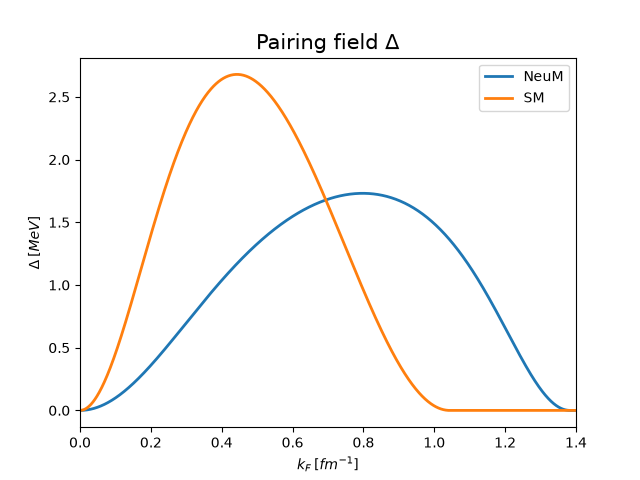
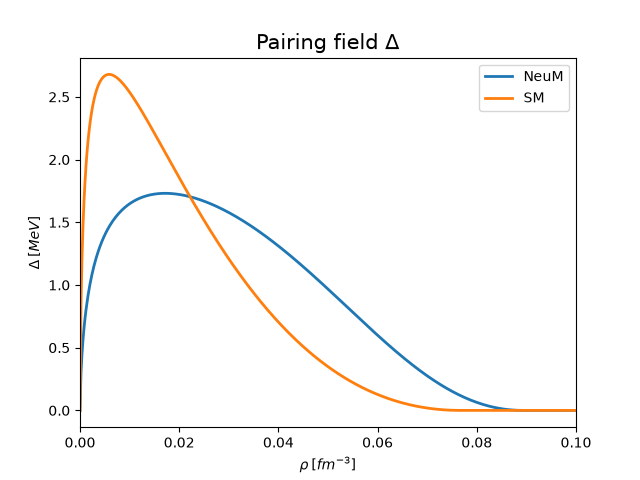
Returns the pairing field for uniform pure neutron nuclear matter. For kF larger than 1.38 fm -1 it returns (numerical) zero.
\[\Delta_{\mathrm{NeuM}}(k_F) = \frac{3.37968 k_F^2}{k_F^2+0.556092^2} \frac{(k_F-1.38236)^2}{(k_F-1.38236)^2+0.327517^2},\]
- libnest.bsk.symmetric_pairing_field(rho_n, rho_p)[source]
Returns the pairing field for uniform symmetric matter. For kF larger than 1.31 fm -1 it returns (numerical) zero.
\[\Delta_{\mathrm{SM}}(k_F) = \frac{11.5586 k_F^2}{k_F^2 + 0.489932^2}\frac{(k_F - 1.3142)^2}{(k_F - 1.3142)^2 + 0.906146^2}.\]
- libnest.bsk.neutron_ref_pairing_field(rho_n, rho_p)[source]
Returns the reference pairing field for neutrons in uniform matter. This is an extrapolation between \(\Delta_{\mathrm{SM}}\) and \(\Delta_{\mathrm{NeuM}}\). In limits \(\eta \rightarrow 0\) reproduces symmetric matter and \(\eta \rightarrow 1\), the neutron matter.
\[\Delta_n(\rho_n,\rho_p) = \Delta_{\mathrm{SM}}(\rho_n+\rho_p) \left( 1 - |\eta| \right) + \Delta_{\mathrm{NeuM}}(\rho_n) \eta \frac{\rho_n}{\rho_n+\rho_p}\]
- libnest.bsk.proton_ref_pairing_field(rho_n, rho_p)[source]
Returns the reference pairing field for protons in uniform matter. This is an extrapolation between \(\Delta_{\mathrm{SM}}\) and \(\Delta_{\mathrm{NeuM}}\). In limits \(\eta \rightarrow 0\) reproduces symmetric matter and \(\eta \rightarrow 1\), the neutron matter.
\[\Delta_p(\rho_n,\rho_p) = \Delta_{\mathrm{SM}}(\rho_n+\rho_p) \left( 1 - |\eta| \right) - \Delta_{\mathrm{NeuM}}(\rho_n) \eta \frac{\rho_p}{\rho_n+\rho_p}\]
- libnest.bsk.neutron_ref_pairing_field_eq2(rho_n, rho_p)[source]
Returns the reference pairing field for neutrons in uniform matter using the interpolation scheme from Eq. (2) of https://link.springer.com/article/10.1140/epja/s10050-025-01503-x
This interpolates between symmetric matter and neutron matter, with asymmetry dependence governed by \(\delta\).
Used in all Bsk parameterizations since Bsk17. Currently in use in WBSK.
\[\Delta_n(\rho_n,\rho_p) = \Delta_{\mathrm{SM}}(\rho) \left(1 - |\delta|\right) + \delta \frac{\rho_n}{\rho} \Delta_{\mathrm{NeuM}}(\rho_n)\]where \(\rho = \rho_n + \rho_p\) and \(\delta = (\rho_n - \rho_p)/\rho\).
- libnest.bsk.proton_ref_pairing_field_eq2(rho_n, rho_p)[source]
Returns the reference pairing field for protons in uniform matter using the interpolation scheme from Eq. (2) of https://link.springer.com/article/10.1140/epja/s10050-025-01503-x
This interpolates between symmetric matter and neutron matter, with asymmetry dependence governed by \(\delta\).
Used in all Bsk parameterizations since Bsk17. Currently in use in WBSK.
\[\Delta_p(\rho_n,\rho_p) = \Delta_{\mathrm{SM}}(\rho) \left(1 - |\delta|\right) - \delta \frac{\rho_p}{\rho} \Delta_{\mathrm{NeuM}}(\rho_p)\]where \(\rho = \rho_n + \rho_p\) and \(\delta = (\rho_n - \rho_p)/\rho\).
- libnest.bsk.neutron_ref_pairing_field_eq3(rho_n, rho_p)[source]
Returns the reference pairing field for neutrons in uniform matter using the interpolation scheme from Eq. (3) of https://link.springer.com/article/10.1140/epja/s10050-025-01503-x
This interpolates between symmetric matter and neutron matter, with asymmetry dependence governed by \(\delta\).
Used in BskG3.
\[\Delta_n(\rho_n,\rho_p) = \Delta_{\mathrm{SM}}(\rho) \left(1 - |\delta|\right) + |\delta| \, \Delta_{\mathrm{NeuM}}(\rho_n)\]where \(\delta = (\rho_n - \rho_p)/\rho\).
- libnest.bsk.proton_ref_pairing_field_eq3(rho_n, rho_p)[source]
Returns the reference pairing field for protons in uniform matter using the interpolation scheme from Eq. (3) of https://link.springer.com/article/10.1140/epja/s10050-025-01503-x
This interpolates between symmetric matter and neutron matter, with asymmetry dependence governed by \(\delta\).
Used in BskG3.
\[\Delta_p(\rho_n,\rho_p) = \Delta_{\mathrm{SM}}(\rho) \left(1 - |\delta|\right) + |\delta| \, \Delta_{\mathrm{NeuM}}(\rho_p)\]where \(\delta = (\rho_n - \rho_p)/\rho\).
- libnest.bsk.neutron_ref_pairing_field_eq6(rho_n, rho_p)[source]
Returns the reference pairing field for neutrons in uniform matter using the interpolation scheme from Eq. (6) of https://link.springer.com/article/10.1140/epja/s10050-025-01503-x
This interpolates between symmetric matter and neutron matter, with asymmetry dependence governed by \(\delta\).
Used in BskG4.
\[\Delta_n(\rho_n,\rho_p) = \Delta_{\mathrm{NeuM}}(\rho_n) \left[ \frac{\Delta_{\mathrm{SM}}(\rho)} {\Delta_{\mathrm{NeuM}}(\rho/2)} \right]^{(1 - \delta)}\]where \(\delta = (\rho_n - \rho_p)/\rho\).
- libnest.bsk.proton_ref_pairing_field_eq6(rho_n, rho_p)[source]
Returns the reference pairing field for protons in uniform matter using the interpolation scheme from Eq. (6) of https://link.springer.com/article/10.1140/epja/s10050-025-01503-x
This interpolates between symmetric matter and neutron matter, with asymmetry dependence governed by \(\delta\).
Used in BskG4.
\[\Delta_p(\rho_n,\rho_p) = \Delta_{\mathrm{NeuM}}(\rho_p) \left[ \frac{\Delta_{\mathrm{SM}}(\rho)} {\Delta_{\mathrm{NeuM}}(\rho/2)} \right]^{(1 + \delta)}\]where \(\delta = (\rho_n - \rho_p)/\rho\).
- libnest.bsk.energy_per_nucleon(rho_n, rho_p)[source]
Returns the energy per nucleon on infinite nuclear matter of given density of protons and neutrons, rho_p and rho_n, respectively, in MeV. Formula (A13) from https://journals.aps.org/prc/pdf/10.1103/PhysRevC.80.065804 [CGP09].
- libnest.bsk.numerical_derivative_energy_per_nucleon_n(rho_n)[source]
First derivative of energy per nucleon, calculated numerically using
numpy.gradient().Args: rho_n (float): rho_n (float): neutron density \(\rho_n\) [fm -3]; sum of both spin components
- Returns
float: derivative of energy per neutron, \(\frac{\delta e_n}{\delta \rho}\) [MeV]
See also
- libnest.bsk.numerical_second_derivative_energy_per_nucleon_n(rho_n)[source]
Second derivative of energy per nucleon, calculated numerically using
numpy.gradient().Args: rho_n (float): rho_n (float): neutron density \(\rho_n\) [fm -3]; sum of both spin components
- Returns
float: second derivative of energy per neutron, \(\frac{\delta^2 e_n}{\delta \rho^2}\) [MeV]
See also
- libnest.bsk.numerical_derivative_epsilon_n(rho_n)[source]
Derivative of energy density \(\epsilon\) with respect to density, calculated numerically using
numpy.gradient()for neutron matter and using theenergy_per_nucleon()function, setting proton density \(\rho_p\) to 0.- Parameters:
rho_n (float) – neutron density \(\rho_n\) [fm -3]; sum of both spin components
- Returns:
Derivative of \(\epsilon\)
- Return type:
See also
- libnest.bsk.numerical_pressure_n(rho_n)[source]
Pressure \(P\) in neutron matter, calculated using the
numpy.gradient()function to calculate the derivative of data calculated byenergy_per_nucleon().- Parameters:
rho_n (float) – neutron density \(\rho_n\) [fm -3]; sum of both spin components
- Returns:
Pressure \(P\)
- Return type:
See also
- libnest.bsk.numerical_derivative_pressure_n(rho_n)[source]
Derivative of pressure \(P\) with respect to density for neutron matter, calculated numerically using
numpy.gradient().- Parameters:
rho_n (float) – neutron density \(\rho_n\) [fm -3]; sum of both spin components
- Returns:
Derivative of \(P\)
- Return type:
See also
- libnest.bsk.numerical_speed_of_sound_n(rho_n)[source]
Velocity of sound in neutron matter dependent on total matter density equal to neutron density \(\rho_n\), given as a percentage of speed of light. Calculated based on numerical data.
- libnest.bsk.energy_per_nucleon_n(rho)[source]
Energy per nucleon on infinite neutron matter of density \(\rho_n\). Derived from formula (A13) from https://journals.aps.org/prc/pdf/10.1103/PhysRevC.80.065804 [CGP09].
- libnest.bsk.derivative_energy_per_nucleon_n(rho)[source]
First derivative of energy per nucleon (for neutrons only).
- Parameters:
rho_n (float) – rho_n (float): neutron density \(\rho_n\) [fm -3]; sum of both spin components
- Returns:
derivative of energy per neutron, \(\frac{\delta e_n}{\delta \rho}\) [MeV]
- Return type:
See also
- libnest.bsk.second_derivative_energy_per_nucleon_n(rho)[source]
Second derivative of energy per nucleon (for neutrons only).
- libnest.bsk.pressure_n(rho)[source]
Pressure \(P\) in neutron matter.
- Parameters:
rho (float) – neutron density \(\rho_n\) [fm -3]; sum of both spin components
- Returns:
Pressure \(P\)
- Return type:
See also
- libnest.bsk.pressure_derivative_n(rho)[source]
Calculates the derivative of pressure \(\frac{\delta P}{\delta \rho}\) in neutron matter.
- libnest.bsk.epsilon_derivative_n(rho)[source]
Calculates the derivative of energy density \(\frac{\delta \epsilon}{\delta \rho}\) in neutron matter.
- libnest.bsk.speed_of_sound_n(rho_n)[source]
Velocity of sound in neutron matter, dependent on total matter density equal to neutron density \(\rho_n\), given as a percentage of speed of light.
- libnest.bsk.isoscalarM(rho_n, rho_p)[source]
Calculates effective isoscalar mass M_s for a given uniform system with neutron and proton densities rho_n and rho_p respectively.
\[\frac{M^*_s}{M} = 2 \left( \frac{M}{M_n^*} + \frac{M}{M_p^*} \right)^{-1}\]
- libnest.bsk.isovectorM(rho_n, rho_p)[source]
Calculates effective isovector mass \(M_v\) for a given uniform system with neutron and proton densities rho_n, rho_p respectively.
\[M^{*}_v = M^{*}_s M_p^{*} \frac{ 2 \rho_p-\rho}{2 M_p^*\rho_p-\rho}\]- Parameters:
- Returns:
effective isovector mass in units of the bare mass, \(M_{v}^{*}/M\) [1]
- Return type:
See also
- libnest.bsk.effMn(rho_n, rho_p)[source]
Returns the effective mass of a neutron in nuclear medium.
\[\frac{M_n^*}{M_n} = \frac{\hbar^2}{2 M_n} \frac{1}{B_n(\rho_n,\rho_p)}\]- Parameters:
- Returns:
neutron effective mass in units of the bare neutron mass, \(M_{n}^{*}/M_n\) [1]
- Return type:
See also
- libnest.bsk.effMp(rho_n, rho_p)[source]
Returns the effective mass of a proton in nuclear medium.
\[\frac{M_p^*}{M_p} = \frac{\hbar^2}{2 M_p} \frac{1}{B_p(\rho_n,\rho_p)}\]- Parameters:
- Returns:
proton effective mass in units of the bare proton mass, \(M_{p}^{*}/M_p\) [1]
- Return type:
See also
- libnest.bsk.U_q(rho_n, rho_p, q)[source]
Returns the mean field potential from density \(\rho\) variation.
rho_q is either rho_n or rho_p.
- libnest.bsk.B_q(rho_n, rho_p, q)[source]
Returns the mean field potential B_q (coming from variation over kinetic density, or effective mass).
\[B_q = \frac{\hbar^2}{2 M^*_q} = \frac{\hbar^2}{2 M_q} + C^\tau_0\rho + C^\tau_1 (\rho_{q} - \rho_{q'})\]- Parameters:
- Returns:
\(B_q = \hbar^2/(2 M^*_q)\) [MeV fm 2]
- Return type:
- libnest.bsk.C0_rho(rho_n, rho_p)[source]
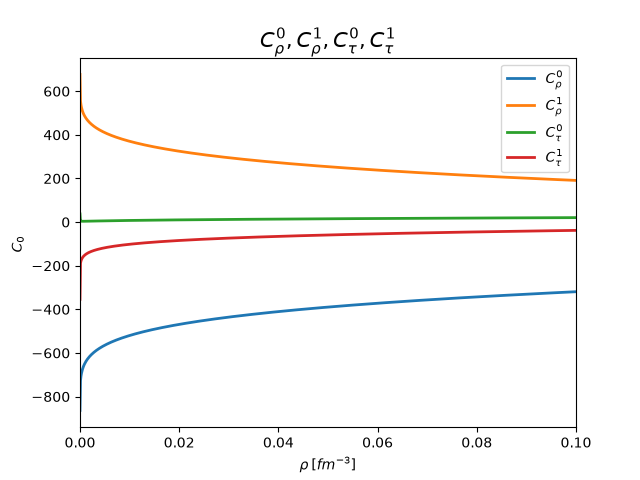
Calculates the energy functional \(C^{\rho}_0\) coefficient [BDEN02].
\[C^0_\rho(\rho) = \frac{3}{8} t_0 + \frac{3}{48} t_3 \rho^\alpha\]
- libnest.bsk.C1_rho(rho_n, rho_p)[source]
Calculates the energy functional \(C^{\rho}_1\) coefficient [BDEN02].
\[C^1_\rho(\rho) = -\frac{1}{4} t_0 \left(\frac{1}{2} + x_0\right) - \frac{1}{24} t_3 \left(\frac{1}{2} + x_3 \right) \rho^\alpha\]
- libnest.bsk.C0_tau(rho_n, rho_p)[source]
Calculates the energy functional \(C^{\tau}_0\) coefficient [BDEN02].
\[C^0_\tau(\rho) = \frac{3}{16} t_1 + \frac{1}{4} t_2 \left(\frac{5}{4} + x_2\right) + \frac{3}{16} t_4 \rho^\beta + \frac{1}{4} t_5 \left(\frac{5}{4} + x_5 \right) \rho^\gamma\]
- libnest.bsk.C1_tau(rho_n, rho_p)[source]
Calculates the energy functional \(C^{\tau}_1\) coefficient [BDEN02].
\[C^1_\tau(\rho) = -\frac{1}{8} t_1 \left( \frac{1}{2} + x_1 \right) + \frac{1}{8} t_2 \left(\frac{1}{2} + x_2\right) - \frac{1}{8} t_4 \rho^\beta \left( \frac{1}{2} + x_4 \right) + \frac{1}{8} t_5 \left(\frac{1}{2} + x_5 \right) \rho^\gamma\]
- libnest.bsk.epsilon_rho_np(rho_n, rho_p)[source]
Energy functional \(\epsilon_{\rho}\) for particle matter, related to the interaction of the nucleons with the background matter density.
\[\varepsilon_\rho(\rho_n,\rho_p) = C^\rho_0(\rho_n+\rho_p) \left( \rho_n + \rho_p \right)^2 + C^\rho_1(\rho_n+\rho_p) \left( \rho_n - \rho_p \right)^2\]
- libnest.bsk.epsilon_tau_np(rho_n, rho_p, tau_n, tau_p, jsum2, jdiff2)[source]
Energy functional \(\epsilon_{\tau}\) for particle matter, related to the density-dependent effective mass. It gives rise to current couplings.
\[\varepsilon_\tau(\rho_n,\tau_n,{ j}_n,\rho_p,\tau_p,{ j}_p) = C^\tau_0(\rho_n+\rho_p) \left[ (\rho_n + \rho_p)(\tau_n + \tau_p) - ({ j}_n + { j}_p)^2 \right] + C^\tau_1(\rho_n+\rho_p) \left[ (\rho_n - \rho_p)(\tau_n - \tau_p) - ({ j}_n - { j}_p)^2 \right].\]- Parameters:
rho_n (float) – neutron density \(\rho_n\) [fm -3]; sum of both spin components
rho_p (float) – proton density \(\rho_p\) [fm -3]; sum of both spin components
tau_n (float) – kinetic density \(\tau\) [fm -5]
tau_n – kinetic density \(\tau\) [fm -5]
jsum2 (float) – sum of momentum density/current vectors \(j\) [fm -3]
jdiff2 (float) – difference of momentum density/current vectors \(j\) [fm -3]
- Returns:
energy functional \(\epsilon_{\tau}\)
- Return type:
- libnest.bsk.epsilon_delta_rho_np(rho_n, rho_p, rho_grad_n_square, rho_grad_p_square, rho_grad_square)[source]
Energy functional \(\epsilon_{\Delta \rho}\) for particle matter, related to the interaction of the nucleons with the background fluctuations.
\[\begin{equation*} \begin{split} \varepsilon_{\Delta\rho}&(\rho_n,\vec\nabla\rho_n,\rho_p,\vec\nabla\rho_p) = +\frac{3}{16} t_1 \left[ \left( 1 + \frac{1}{2}x_1\right) \left( \nabla(\rho_n+\rho_p) \right)^2 -\left(\frac{1}{2} + x_1 \right) \sum_q \left( \nabla\rho_q \right)^2 \right] \\ &- \frac{1}{16}t_2 \left[ \left( 1 + \frac{1}{2} x_2\right) \left( \nabla(\rho_n+\rho_p) \right)^2 + \left( \frac{1}{2} + x_2\right) \sum_{q} \left( \nabla\rho_q\right)^2 \right] \\ &+\frac{3}{16} t_4 (\rho_n+\rho_p)^\beta \left[ \left(1 + \frac{1}{2}x_4\right) \left( \nabla(\rho_n+\rho_p) \right)^2 - \left(\frac{1}{2} + x_4 \right) \sum_q \left( \nabla\rho_q \right)^2 \right] \\ &+ \frac{\beta}{8}t_4 (\rho_n+\rho_p)^{\beta-1} \left[ \left(1 + \frac{1}{2}x_4\right) (\rho_n+\rho_p)\left(\nabla(\rho_n+\rho_p)\right)^2 - \left(\frac{1}{2} + x_4 \right) \nabla(\rho_n+\rho_p)\cdot\left(\sum_q \rho_q\nabla\rho_q\right) \right] \\ &- \frac{1}{16}t_5 (\rho_n+\rho_p)^\gamma \left[ \left( 1 + \frac{1}{2} x_5\right) \left( \nabla(\rho_n+\rho_p)\right)^2 +\left(\frac{1}{2} + x_5\right) \sum_{q} \left( \nabla\rho_q\right)^2 \right]. \end{split} \end{equation*} \]- Parameters:
rho_n (float) – neutron density \(\rho_n\) [fm -3]; sum of both spin components
rho_p (float) – proton density \(\rho_p\) [fm -3]; sum of both spin components
rho_grad_n_square (float) – neutron density gradient squared \(\nabla \rho\) [fm -8]
rho_grad_p_square (float) – proton density gradient squared \(\nabla \rho\) [fm -8]
rho_grad_square (float) – total density gradient squared \(\nabla \rho\) [fm -8]
- Returns:
energy functional \(\epsilon_{\Delta \rho}\)
- Return type:
- libnest.bsk.epsilon_np(rho_n, rho_p, rho_grad_n, rho_grad_p, tau_n, tau_p, jsum2, jdiff2, nu_n, nu_p, kappa_n, kappa_p)[source]
Calculates the total energy functional \(\epsilon\), with a limit for single-particle energies \(\epsilon_{\Lambda}\) = 6.5 MeV.
\[\varepsilon(\rho_n,\vec\nabla\rho_n, \tilde{\rho}_n,\tau_n,{ j}_n,\rho_p,\vec\nabla\rho_p,\tilde{\rho}_p,\tau_p,{ j}_p) = \nonumber \\ = \frac{\hbar^2}{2 M_n} \tau_n + \frac{\hbar^2}{2 M_p} \tau_p + \varepsilon_\rho(\rho_n,\rho_p) + \varepsilon_\tau(\rho_n,\tau_n,{ j}_n,\rho_p,\tau_p,{ j}_p) \nonumber \\ + \varepsilon_{\Delta\rho}(\rho_n,\vec\nabla\rho_n,\rho_p,\vec\nabla\rho_p) + \varepsilon_\pi(\rho_n,\vec\nabla\rho_n,\tilde{\rho}_n,\rho_p,\vec\nabla\rho_p,\tilde{\rho}_p), \]- Parameters:
rho_n (float) – neutron density \(\rho_n\) [fm -3]; sum of both spin components
rho_p (float) – proton density \(\rho_p\) [fm -3]; sum of both spin components
rho_grad_n (float) – neutron density gradient \(\nabla \rho\) [fm -4]
rho_grad_p (float) – proton density gradient \(\nabla \rho\) [fm -4]
tau_n (float) – kinetic density \(\tau\) [fm -5]
tau_n – kinetic density \(\tau\) [fm -5]
jsum2 (float) – sum of momentum density/current vectors \(j\) [fm -3]
jdiff2 (float) – difference of momentum density/current vectors \(j\) [fm -3]
nu_n (float) – neutron anomalous density \(\nu\) [fm -3]
nu_p (float) – proton anomalous density \(\nu\) [fm -3]
kappa_n (float)
kappa_p (float) – what is kappa? (no Eq.9 in Ref.41)
TO DO: write eq for jsum2 and jdiff2
- Returns
float: energy functional \(\epsilon\)
- libnest.bsk.epsilon_pi_np(rho_n, rho_p, rho_grad_n, rho_grad_p, nu_n, nu_p, kappa_n, kappa_p)[source]
Energy functional \(\epsilon_{\pi}\) for particle matter, related to pairing energy density.
\[\varepsilon_\pi(\rho_n,\vec\nabla\rho_n,\tilde{\rho}_n,\rho_p,\vec\nabla\rho_p,\tilde{\rho}_p) =\frac{1}{4} f^\pm_n \left( v^{\pi n}(\rho_n,\rho_p) + \kappa_n|\nabla\rho_n|^2 \right) \tilde{\rho_n}^2 +\frac{1}{4} f^\pm_p \left( v^{\pi p}(\rho_n,\rho_p) + \kappa_p|\nabla\rho_p|^2 \right) \tilde{\rho_p}^2,\]- Parameters:
rho_n (float) – neutron density \(\rho_n\) [fm -3]; sum of both spin components
rho_p (float) – proton density \(\rho_p\) [fm -3]; sum of both spin components
rho_grad_n (float) – neutron density gradient \(\nabla \rho_n\) [fm -4]
rho_grad_p (float) – proton density gradient \(\nabla \rho_p\) [fm -4]
nu_n (float) – neutron anomalous density \(\nu_n\) [fm -3]
nu_p (float) – proton anomalous density \(\nu_p\) [fm -3]
kappa_n – \(\kappa_n\) (float)
kappa_p – \(\kappa_p\) (float)
- Returns:
energy functional \(\epsilon_{\pi}\) [MeV]
- Return type:
See also
- libnest.bsk.v_pi(rho_n, rho_p, q)[source]
Calculates pairing strength \(\upsilon^{\pi}_q\) for neutrons or protons, for energies below 6.5 MeV.
Based on Equation 14 from Phys Rev C 104. Check [PkecakCMWlazlowski21] and earlier papers of Chamel.
Note
This function handles both neutron (q=’n’) and proton (q=’p’) cases with the same implementation. Consider splitting into separate functions for better code organization if species-specific modifications are needed.
\[v^{\pi q}(\rho_n,\rho_p) = - \frac{8 \pi^2}{I_q(\rho_n,\rho_p) } B_q(\rho_n,\rho_p)^{3/2}\]- Parameters:
- Returns:
pairing strength \(\upsilon^{pi}\) [fm -3]
- Return type:
- libnest.bsk.I(rho_n, rho_p, q)[source]
Approximates the solution to the integral present in the original \(\nu^{\pi}\) formula for single-particle energies below 6.5 MeV. Check [PkecakCMWlazlowski21] and earlier papers of Chamel.
\[I_q(\rho_n,\rho_p) = \sqrt{\mu_q(\rho_n,\rho_p) } \left( 2 \ln{\frac{2 \mu_q(\rho_n,\rho_p) }{\Delta_q(\rho_n,\rho_p) }} + \Lambda\left( \frac{\varepsilon_\Lambda}{\mu_q(\rho_n,\rho_p) } \right) \right)\]