Software
W-BSk Toolkit
A toolkit for 3D simulations of the inner crust of neutron stars, where nuclei are immersed in superfluid neutron matter. It solves static and time-dependent problems at zero and finite temperatures without any symmetry constraints, using nuclear energy density functionals of the Brussels-Montreal (BSk) family. W-BSk shares its core engine with the W-SLDA Toolkit and is designed for GPU-accelerated supercomputers. It is open source under the GNU GPL license.
Website,
Source code (GitLab),
Paper (Phys. Rev. X 14, 041054)
libNeST 
Library for Neutron Star physics: a Python library for nuclear matter and neutron star calculations based on the Brussels-Montreal (BSk) energy density functional. It provides the equation of state, effective masses, pairing fields, the structure of the inner crust and its pasta phases, conversions between nuclear and astrophysical units, and ready-to-use plots. It is open source under the MIT license and can be installed with pip install libnest.
Documentation,
Source code (GitHub),
PyPI
Hobby projects
There is nothing more enjoyable than solving a mystery. Many (simple) things are mysteries for me but the simplicity does not take a bit from the fun that is connected with playing with new (or sometimes quite old) ideas.
Travelling Daniel Problem (Genetic algorithm)
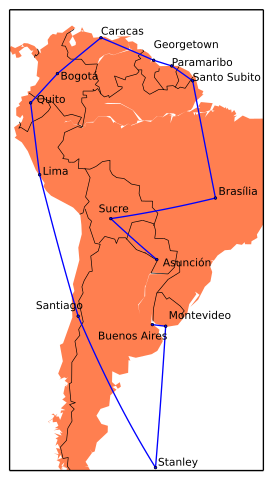
The problem is as follows: for a given list of cities (let's say the capital cities of South America) we want to find the shortest path. By going along this path we want to visit every city only once (the problem is known as Travelling Salesman Problem). Even for such a small number of cities, we have a lot (12!=479,001,600) of possibilities. It's easy to imagine that harnessing the brute force will quickly fail after adding a few more destinations. A possible way to solve this problem is a genetic algorithm which optimizes paths around the continent by evolution. We do not know if we will get the shortest path, but it is very close to the shortest (see figure).
Lennard-Jones gas (CUDA)
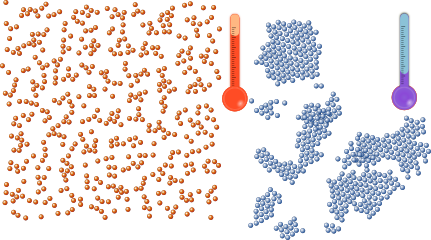
This project was about simulating the Lennard-Jones model of a gas. In this model, it is assumed that gas interacts via van der Waals forces. This many-body problem may be easily parallelized and solved much faster with CUDA graphic cards (orders of magnitude faster). Here in the picture, one can see a structure that is forming when the temperature is lowered and gas is solidifying.